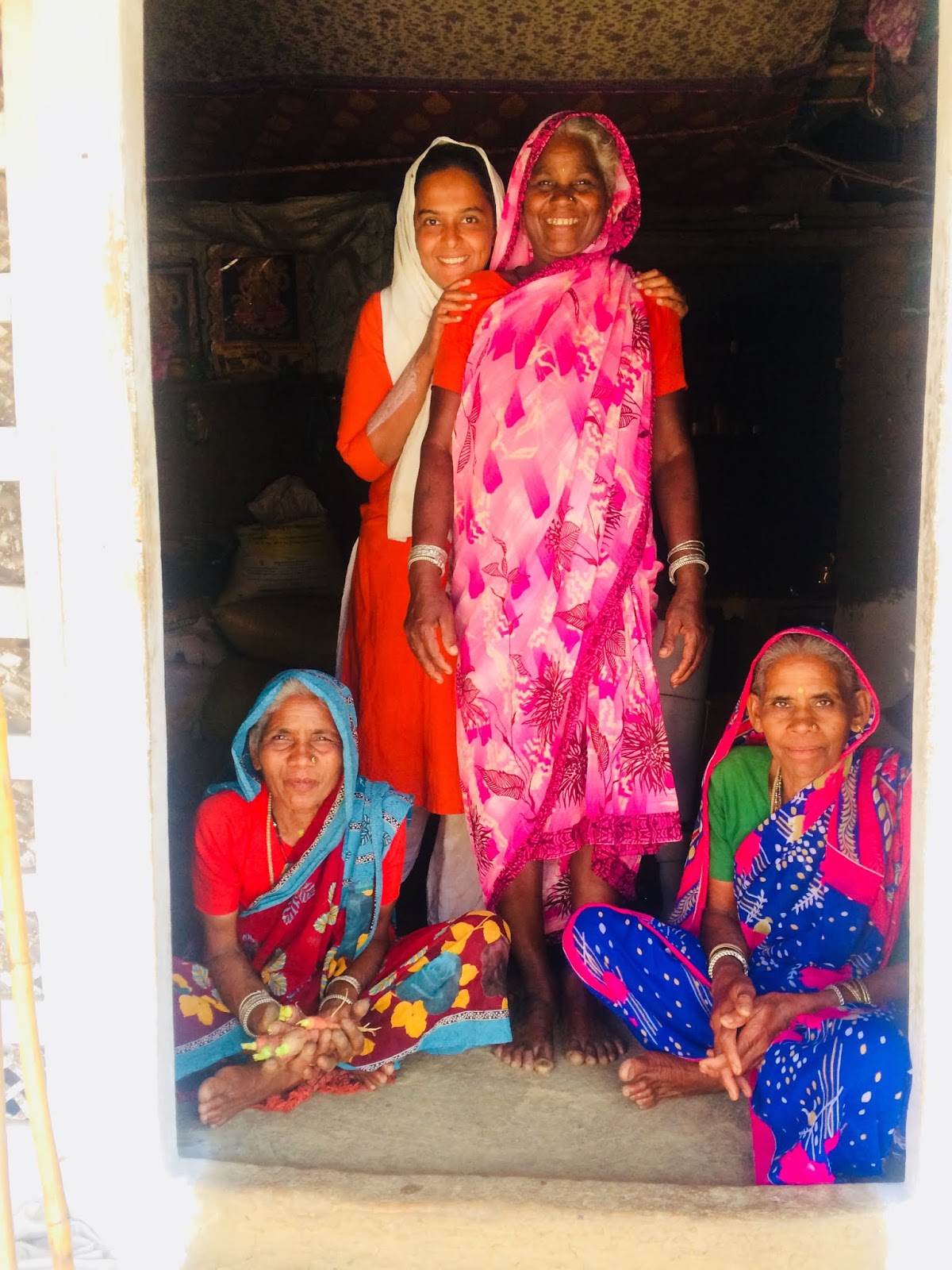
Before we started our walk, we went to Brahma Vidhya mandir, Pavnar, to seek blessings from the elders, some of whom have walked thousands of kilometers as part of the land gift movement along with Vinoba Bhave.
I remember having a conversation with Usha tai around ego and relationships. To expand on the idea she shared about one of the practices they follow in the ashram, Sarvanumati, i.e., consent of all. This meant that, from the smallest to the biggest decisions, all were made only after each and every one in the ashram had reached consensus. There are thirty of them living in the ashram for many years, practicing the same principle.
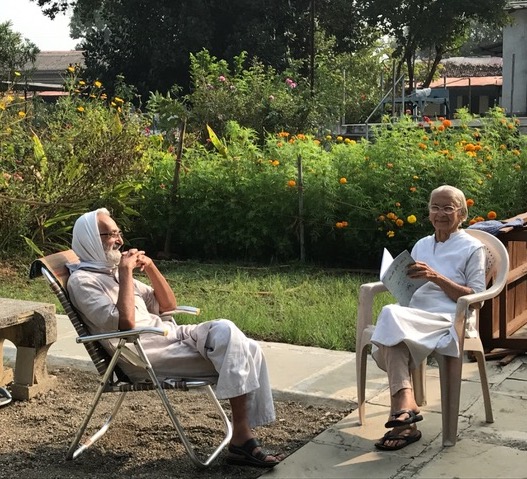
She explained further with an example, saying, "If I want to conduct a workshop at the ashram, the proposal will be put across to everyone in a meeting. If everyone agrees, I will go ahead. But if even one person is unwilling to attend that workshop, the event will remain on standby. Unlike the majority, where 51% wins against 49%, which happens in a democracy. 49% is equivalent to zero. But in the case of Sarvanumati, even if 99% of people agree on one thing, the 1% view is equally taken into consideration because "h one matters."
We asked her, "How do you feel when your project or something that you really want to do is put on standby or told no?"
She very gracefully answered, asking us, "What matters more to my project or my love for the other person who is saying no? Yes, to some extent my ego will feel bad becau "e "there is an "I" a "sociated w "th "my project" but if I can extend my boundaries of love for the ot" e" person doesn't really "oesn't matter."
Here is a small note by Vinoba ji that I found on ways and means to bring consensus and the difference between Sarvanumati and Sarva sammati.
On that note, SheelaTai, in a different conversation, said something equally powerful. She said, "No matter what, it doesn't mean someone's breaking someone's heart. It is a very sacred place, and it reminded me of a poem by Rum, i inwhich says:
Just thinking how would the world be if we looked at each heart as Kaaba, as a place of pilgrimage:)
I remember having a conversation with Usha tai around ego and relationships. To expand on the idea she shared about one of the practices they follow in the ashram, Sarvanumati, i.e., consent of all. This meant that, from the smallest to the biggest decisions, all were made only after each and every one in the ashram had reached consensus. There are thirty of them living in the ashram for many years, practicing the same principle.
She explained further with an example, saying, "If I want to conduct a workshop at the ashram, the proposal will be put across to everyone in a meeting. If everyone agrees, I will go ahead. But if even one person is unwilling to attend that workshop, the event will remain on standby. Unlike the majority, where 51% wins against 49%, which happens in a democracy. 49% is equivalent to zero. But in the case of Sarvanumati, even if 99% of people agree on one thing, the 1% view is equally taken into consideration because "h one matters."
We asked her, "How do you feel when your project or something that you really want to do is put on standby or told no?"
She very gracefully answered, asking us, "What matters more to my project or my love for the other person who is saying no? Yes, to some extent my ego will feel bad becau "e "there is an "I" a "sociated w "th "my project" but if I can extend my boundaries of love for the ot" e" person doesn't really "oesn't matter."
Here is a small note by Vinoba ji that I found on ways and means to bring consensus and the difference between Sarvanumati and Sarva sammati.
On that note, SheelaTai, in a different conversation, said something equally powerful. She said, "No matter what, it doesn't mean someone's breaking someone's heart. It is a very sacred place, and it reminded me of a poem by Rum, i inwhich says:
Circle the Kaaba of the heart
If you possess a heart.
The heart is the true Kaaba,
The other is just a stone.
God enjoined the ritual
Of circling the formal Kaaba
As a way for you to find a heart.
But if your feet walk
Around the Kaaba a thousand times,
And yet you injure a heart,
Do you expect to be accepted?
Just thinking how would the world be if we looked at each heart as Kaaba, as a place of pilgrimage:)